Anyone who has stood on a Singapore worksite at 1pm knows the heat is not just uncomfortable. It can make you ill. From Tuesday, 1 December 2026, the Ministry of Manpower (MOM) is turning four heat-safety practices from "strongly recommended" into "must do" for employers.
If you work outdoors, manage people who do, or simply wonder why some crews seem to take more water breaks these days, here is what is changing and what is not.
The four practices that become mandatory
MOM says these four were already recommended and widely adopted by employers. From 1 December, employers must:
- Run a heat stress training programme for workers exposed to heat. The Workplace Safety and Health (WSH) Council describes this as training workers and supervisors to recognise heat stress risks and the signs of heat-related illness, and how to protect themselves and colleagues.
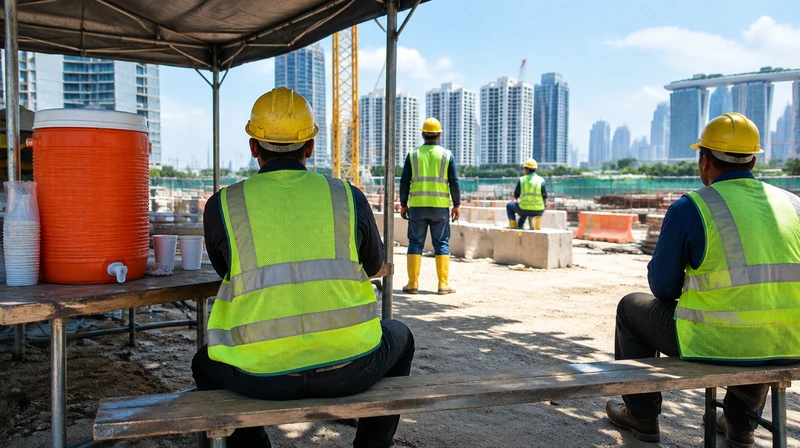
- Provide a cool drinking water supply near work areas.
- Keep cold water, ice packs or water spray on standby for emergencies, so someone showing signs of heat illness can be cooled quickly.
- Provide suitable clothing that helps protect against excessive heat, such as loose, breathable, moisture-wicking attire.
One new practice is recommended, not required: shaded rest areas that are well ventilated and either insulated or cooled.
What already applies: the heat-and-rest rules
The existing framework is built around the Wet Bulb Globe Temperature (WBGT), a measure that factors in humidity, wind and sunlight, not just air temperature. "Outdoor work" means work done primarily in the open without permanent shade. According to MOM's page, employers must monitor WBGT every hour of outdoor work, and the measures step up as it rises:
- Below 31°C: new or returning workers are acclimatised gradually over at least 7 days, cool water is available, and workers get adequate rest in the shade.
- 31°C to below 33°C: workers must drink at least hourly (300ml an hour or more, depending on work intensity), heavy work is moved to cooler parts of the day where feasible, and a buddy system and closer health monitoring apply.
- 33°C and above: hourly rest breaks of at least 15 minutes for heavy physical work, longer as WBGT climbs, cold water and ice packs on standby, and vulnerable workers moved to non-outdoor work.
MOM's table also lists hourly breaks of at least 10 minutes for heavy physical work once WBGT reaches 32°C.
Where do workers and the public see the WBGT?
Employers can use on-site meters (required at larger construction sites, shipyards and the process industry) or the NEA's myENV app. If you are curious how the same measure is shown to the general public, we explained it here:
If you are a worker
You do not have to memorise the table. A few simple checks are enough: Is there cool water close by? Were you shown what heat illness looks like? Is there somewhere shaded to rest? Is there ice or cold water ready if someone feels unwell? Feeling dizzy, faint or unusually exhausted in the heat is a reason to stop and tell your supervisor, not to push on.
If you think your workplace is not following the rules, MOM's website is the place to look for the current ways to raise it. The pages we read did not set out a reporting route or the penalties for non-compliance, so please check MOM directly.
If you run a team
MOM gave employers three months from its 28 August announcement to prepare, and it says it will support employers through outreach with tripartite partners and industry stakeholders. The WSH Council has also published guidelines on managing heat stress at the workplace.
A last word
Rules on paper only help when they show up as a cup of water within reach and a shaded spot to sit. If your team already does all this, good. If not, 1 December is a fair deadline to start.
Details can change, so please confirm requirements with MOM before relying on this article.