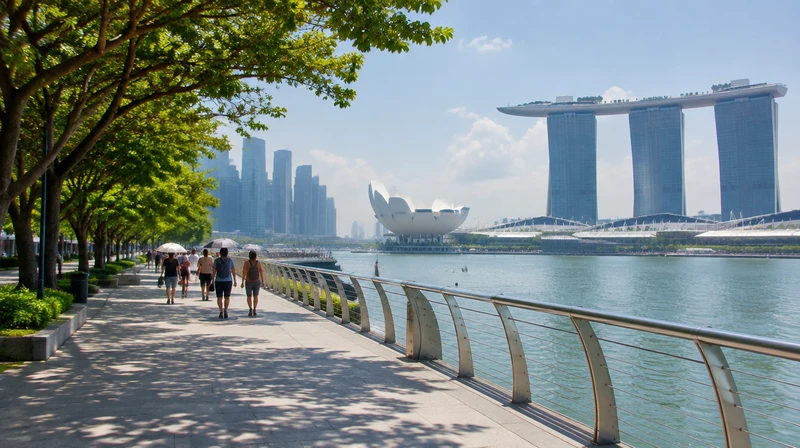
Singapore is always warm, but this year has been hotter than usual. NTU researchers report 51 high heat stress days in the first half of 2026, and the Meteorological Service expects El Niño to keep conditions warm. If you plan outdoor activities, the Heat Stress Advisory is a handy tool to check before you head out.
Quick summary
- The advisory has three levels: low, moderate and high.
- Check it on the myENV app or at weather.gov.sg.
- The level is based on the nearest sensor reading.
- Take shade breaks, drink water and wear light clothing.
How the Heat Stress Advisory works
Credit: InSingapura.com (AI-assisted)
The advisory was launched in July 2023 by the Ministry of Sustainability and the Environment (MSE) and NEA to help people plan prolonged outdoor activities. It uses three levels, low, moderate and high, based on the Wet Bulb Globe Temperature (WBGT) reading from the sensor nearest to you. You can check it on the myENV app (update to the latest version) or on weather.gov.sg's heat stress map.
The sensor network has grown from 9 sensors in 2023 to 27 as of May 2026, and more are planned, which gives more location-specific readings. NTU researchers note that this expansion partly explains the higher count of recorded heat stress days, alongside long-term warming.
If you are exercising, working outdoors or supervising children, also follow sector guidance, such as the Ministry of Manpower's framework for outdoor work and Ministry of Education guidelines for schools.
Simple habits, and what happens in a heatwave

Credit: InSingapura.com (AI-assisted)
- Check the heat stress level before you go outdoors.
- Drink water regularly, even if you do not feel thirsty.
- Wear light, breathable clothing and take regular breaks in the shade.
- Look out for seniors, young children and anyone with a health condition, who are more vulnerable to heat-related illness.
- Consider shifting walks and sports to early morning or evening when levels are high.
Heatwave plans. The Government has announced a national heatwave response plan. As reported, a heatwave is declared when the daily highest temperature averages 35 degrees C over three consecutive days, with a daily mean of at least 29 degrees C, and the public would be alerted through myENV at least four days ahead. More than 300 air-conditioned cooling centres would open islandwide, with locations announced only when the plan is activated. During a declared heatwave, pre-schools and nursing homes should avoid outdoor activities between 11am and 4pm.