Here is a little Singapore pet puzzle. You live in a four-room HDB flat and you'd love a dog and a couple of cats. How many can you have, and does the licence mean you are allowed to keep them?
The answers are "one small dog and two cats, tops" and "no, a licence is not a permission slip". Those two points trip up a lot of new owners, and the pet cat rules got firmer this year. The cat licensing grace period ended on 31 August 2026. From 1 September, keeping an unlicensed pet cat is an offence under the Animals and Birds Act, and NParks says owners who break the cat-keeping rules or licence conditions can be fined up to S$5,000.
Here is the whole picture in plain English.
The quick version
- HDB flat: up to two cats, plus one dog from HDB's approved breed list (crosses of two listed breeds count).
- Private homes: up to three cats and dogs in total, and only one "Specified" dog per premises.
- Every pet cat must be microchipped and licensed. First-time cat or dog licence applicants must also finish a free, one-time online pet ownership course.
- A licence does not grant permission to keep the animal where you live. HDB or your estate management decides that.
- Breaking HDB's pet limits can bring a fine of up to S$4,000.
Dogs and cats in HDB flats: the exceptions that surprise people
Dogs. HDB allows one dog per flat, and it must be from its approved breed list. Dogs that are a cross of two listed breeds count too, and approved breeds don't need separate HDB approval, though the dog still needs an NParks AVS licence. Breaching the one-dog rule can bring a fine of up to S$4,000.
There are a few well-known exceptions. Under Project ADORE, residents can adopt one local mixed-breed "Singapore Special" up to 55cm tall, after screening and with mandatory obedience training. The ADORE K-9 Scheme lets residents adopt a retired sniffer dog of four breeds (Labrador, English Springer, Cocker Spaniel or Pointer). Residents with visual, physical or hearing impairments can also keep a trained assistance dog, as long as they are registered with MSF and the dog is trained by a recognised organisation and licensed.
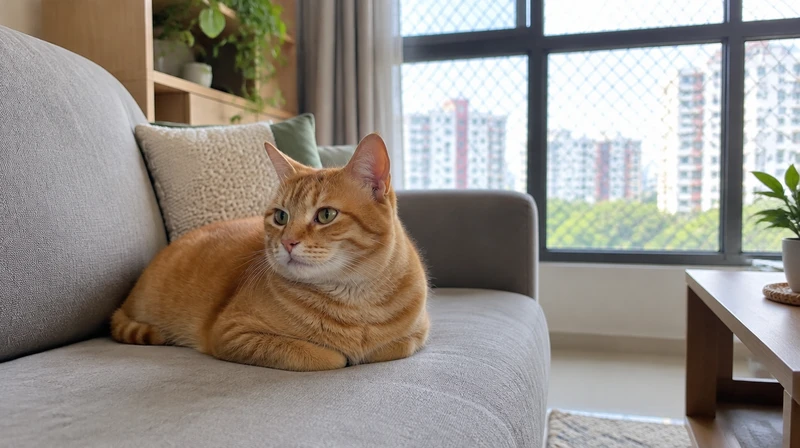
Cats. Each HDB unit may keep up to two cats. Cats owned before 1 September 2024 could be kept beyond that limit, but only if they were licensed during the transition period, and owners had to declare this when applying. The limits now apply to all new licence applications. Owners must keep cats safe at home, such as with mesh or grilles on windows and balconies, and under physical control in public, for example in a carrier or on a harness.
Fostering is a special case. A two-year pilot from 3 August 2026 to 31 July 2028 lets approved cat fosterers keep up to six cats in 3-room or larger HDB sold flats, or up to ten in private premises. All the cats in the household must be sterilised, and licence fees are waived for foster cats during the pilot.
Private homes. A private property can keep up to three cats and dogs in total. If one of them is a "Specified" dog, only one is allowed per premises and the rest of the mix is capped at two. Keeping more than three needs prior AVS approval, which looks at things like secure housing, microchipping and sterilisation, and good control of the animals.
Getting a licence: steps, fees and where to get help
The steps. Have your pet microchipped by a licensed vet, finish the free online pet ownership course (about 20 to 30 minutes, according to Home & Decor), then apply through the Pet Animal Licensing System (PALS). Renew before the licence expires, update the address if you move, and cancel the licence if the pet goes missing, is permanently exported or dies. Mothership reported that more than 111,000 pet cats had been licensed by the end of the transition period.
The fees. From 1 September 2026, the AVS fee table covers cats and dogs together. As we read the NParks page, animals under five months old pay S$15. For the first three animals, a sterilised pet pays S$15 for a one-year licence, S$25 for two years and S$35 for a one-time licence, while a non-sterilised pet pays S$90 for one year, S$165 for two years and S$230 for three years. The fourth and later animals cost more, with a reduced fee for a fourth pet that is a local mixed-breed dog or comes from an AVS rehoming partner. Parts of the online table are hard to read, so please check the exact amounts on the AVS licensing page or PALS before you apply.
If money is tight. AVS's Pet Cat Sterilisation Support programme offers free sterilisation and microchipping for lower-income households. Register at go.gov.sg/avs-pcss.
Who to call. HDB handles pets beyond the approved limits, NEA handles pets that foul public areas, NParks AVS handles licensing, dogs that chase or bite and animal welfare, and MSF supports persons with disabilities who use assistance dogs.
The honest bit. The pet rules involve three agencies and a few moving parts, and they have changed quite a lot in two years. If you are about to adopt, check the HDB breed list and your estate's rules first, so the family doesn't fall in love with a pet it cannot keep.