
When we were kids, the rules were simple. Don't talk to strangers. Don't follow someone you don't know. If something feels wrong, tell a grown-up straight away.
Here's the funny thing: those rules work just as well for adults. Today's scammers are basically strangers with a good story. They may say they are your friend, your bank, a recruiter or even the police, and they often reach us through the phone in our pocket: a text, a WhatsApp message, a phone call or an online ad.
This guide explains scams the way you would explain it to a child, with real Singapore examples. The five rules below match what the Singapore Police Force (SPF), ScamShield, GovTech, MAS's MoneySense and others say about how scams work.
If you remember only one thing, remember this: stop, don't rush, and check with someone you trust before you click, pay or share anything.
Rule 1: If it sounds too good to be true, it probably is

Credit: Artem Beliaikin / Flickr via Wikimedia Commons, CC BY 2.0. Image resized from the original.
You know how a stranger offering you free sweets should make you suspicious? Same idea. When someone offers a deal that is far better than anything normal, ask yourself one question: why is this person being so generous to me?
Singapore's authorities and banks describe the same pattern again and again. Scammers dangle something attractive, then use it to get your money or your details. Here is what that looks like:
- Investments with big returns and no risk. MAS's MoneySense says offers that promise high returns while protecting your capital are a red flag, because higher promised returns usually come with higher risk. The CPF Board lists the same warning sign.
- Jobs that pay a lot for easy work. MOM's scam-safety guide for migrant domestic workers says job offers promising high pay for easy work are likely scams. Randstad, a recruitment firm, adds that pay far above the usual rate for the role is the first sign of a fake job.
- Prices far below normal. UOB lists deals that look too good as a red flag for online shopping scams.
So when someone shares a "lobang" that is a little too good, slow down. Real sales and real jobs do exist, but they don't need you to hurry, keep quiet or pay first. More on that below.
Rule 2: Be careful with strangers who message you first

Credit: Rawpixel / Wikimedia Commons, CC0. Image resized from the original.
You wouldn't chat with a stranger who walks up to you in the playground and starts asking for things. Online, the "stranger" often arrives as a text, a WhatsApp or Telegram message, a social media ad, a call from an unknown number, or a new online friend.
What to watch for
Unknown group chats. MoneySense lists offers from unknown group chats and new online "friends" as red flags for investment scams, and UOB points to invitations to chats from people you don't know.
Job offers you never applied for. Randstad calls this a strong sign of a scam.
Love that moves too fast. UOB's love-scam red flags include rapid emotional escalation, a partner who is always overseas, meetings that keep getting cancelled, and requests for money.
A "friend" who suddenly needs money urgently. ScamShield describes fake friend call scams, where someone poses as a friend and asks for money in a hurry. Call your friend on the number you already have to check.
Unknown or foreign numbers. GovTech notes that scammers can spoof numbers, so even a +65 number from an unknown sender should not be trusted.
Clickable links in "official" SMSes. GovTech says SingPost and Singapore banks stopped sending clickable links in official SMSes as of 28 February 2022, so a link in a message claiming to be from them is suspicious.
It is the same rule as the one we learnt as kids: if you did not start the conversation and you don't know the person, don't hand over anything. Not your money, not your passwords and not your OTP.
Rule 3: Scammers rush you, scare you and tell you to keep it secret

Credit: Shixart1985 / Wikimedia Commons, CC BY 2.0. Image resized from the original.
A stranger who says "Quick, come with me, and don't tell anyone!" is a stranger to run away from. Scammers use the same trick on adults. They make you feel scared or hurried so that you act first and think later.
Common pressure tactics
"Limited time" offers, special rates for early investors, and claims that many others have already joined (MoneySense).
A sudden problem with your bank account, with a link to click so you can "fix" it (MOM's phishing warning).
Fines, bail or a money-laundering investigation, plus demands to keep it secret (UOB).
A real example
A Straits Times report from June 2026 told the story of a woman who got a call from someone claiming to be from her bank about card fraud. She was passed to a fake police officer and a fake MAS officer, who said she was a money-laundering suspect who would have to go to court and whose assets would be frozen. Within three to four hours she had moved about half her money into a new account, and she was getting ready to move the rest when her bank stepped in.
Experts quoted in the report gave simple advice. Pause and ask whether the story makes sense, because scammers target fast, instinctive thinking. Bring in a trusted person, such as a family member, friend or bank staff, before a big transaction. The report also says that since 15 October 2025, banks hold or reject transfers of more than half the funds in accounts with $50,000 or more, which gives customers 24 hours to reconsider.
The takeaway: the more urgent and scary a message feels, the more reason to stop and breathe. A real bank or agency can wait while you check with them through their official app or website.
Rule 4: Real people don't ask you to pay first, or to pay in strange ways
Credit: InSingapura.com (AI-assisted)
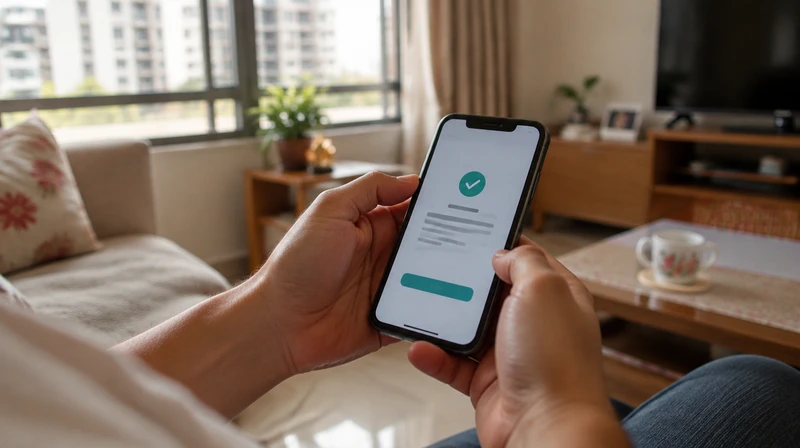
If a stranger said "give me your pocket money first and I'll give you a toy later", no child would agree. Yet "pay first" is one of the most common scam tricks.
Pay-first tricks
Jobs: payments for training, equipment or fees (UOB), or for insurance, medical tests or visa applications (Randstad, who say genuine employers and agencies cover these).
Loans: MOM says licensed moneylenders cannot advertise in Singapore, so unwanted loan ads and instant-approval offers should be ignored, blocked and reported. Scammers ask for upfront fees and may then vanish.
Investments: Standard Chartered says victims may be asked to pay administrative fees, security fees or taxes to "unlock" profits, after which the scammers disappear.
Strange ways to pay
Transfers to personal bank accounts or PayNow numbers (DBS).
Payment outside the official platform, in cryptocurrency, or through links and third-party apps (UOB).
Cash or gold. In government officials impersonation scams, SPF says victims are told to withdraw cash, buy gold bars or hand over valuables to a so-called agent, and that real police officers will never send anyone to collect cash or valuables.
GovTech also notes that government transactions usually need a Singpass login, and that PayNow is not offered as a payment option. So a "government" request to pay by PayNow is a big warning sign.
Rule 5: Check who you are really talking to
Credit: CEphoto, Uwe Aranas / Wikimedia Commons, CC BY-SA 4.0. Image resized from the original.
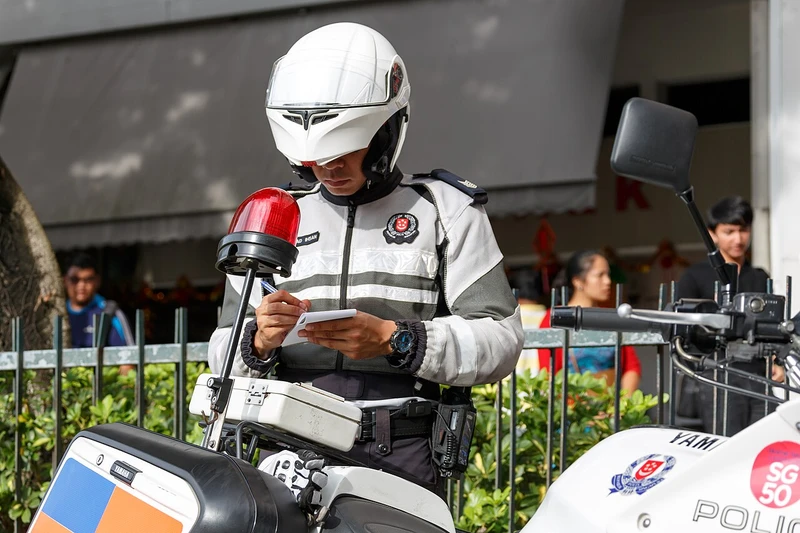
Imagine a stranger who says, "Your mummy asked me to pick you up." A sensible child would check with mummy first. Scammers pretend to be someone you trust, so the same habit helps: check through a channel you already know is real.
What real officials never do
SPF's advisory of 1 September 2025 on government officials impersonation scams says that, over a phone call, real officials will not do any of these:
- ask you to transfer money
- ask for your banking login details
- ask you to install apps from unofficial app stores
- transfer your call to the Police
SPF also issued an advisory in April 2026 about phishing scams involving Google Meet video calls from people impersonating its officers, so even a video call is not proof of who someone is.
How to spot a fake website or message
Singapore government websites use gov.sg in the address. GovTech gives police-gov.com as an example of a lookalike that should make you suspicious.
Short links ending in go.gov.sg, for.sg and for.edu.sg can only be created by public officers, healthcare officers and education officers respectively, according to GovTech.
If a message claims to be from a government organisation, GovTech says you can check the link against the trusted sites list at gov.sg/trusted-sites.
Generic sender names, spelling mistakes and requests to download an app from outside the official app stores are warning signs. GovTech notes that scammers have even impersonated ScamShield this way.
Logos can be copied, so a good-looking message is not proof that it is real.
What do scams look like in Singapore right now?

Credit: InSingapura.com (AI-assisted)
These rules are not just theory. According to the Singapore Police Force's Mid-Year Scam and Cybercrime Brief 2026, there were 18,391 scam and cybercrime cases from January to June 2026, down 17.9% from the same period in 2025. Scam losses were about S$410.6 million, and the median loss per scam case was S$1,350. Things are improving, but plenty of people are still being caught.
Top five scam types by number of cases
- E-commerce scams: 3,865 cases. Think fake sellers and prices that look too good.
- Phishing scams: 3,104 cases. Fake messages and links that try to steal your details.
- Investment scams: 2,256 cases. Big returns with little or no risk.
- Job scams: 2,247 cases. Easy money for simple tasks.
- Government officials impersonation scams: 1,363 cases. Fake officers and invented problems.
The money tells another story. By amount lost, investment scams came first at S$169.8 million, followed by government officials impersonation scams at S$90.8 million, business email compromise scams at S$57.3 million, job scams at S$34.9 million and phishing scams at S$9.6 million.
A scam type with fewer cases can still cost people more. Investment scams were third by number of cases but first by amount lost.
Quick checklist: is it a scam?

Credit: InSingapura.com (AI-assisted)
Next time something lands on your phone, run through this list. One tick is a reason to stop. Two or more means please don't go any further.
It sounds too good to be true: huge returns, easy money or a very low price.
A stranger contacted you first, by call, text, chat app, social media or group chat.
You are being rushed, with lines like "limited time", "act now" or "your account will be frozen".
You are told to keep it secret.
You are asked to pay first: fees, deposits, taxes, training or equipment.
You are asked to pay in an odd way: PayNow or bank transfer to a person, cryptocurrency, cash or gold.
They want your OTP, password, Singpass details or banking login. GovTech calls requests like this a major warning sign.
You are told to click a link or install an app from outside the official app stores.
The sender, phone number or website address looks slightly off.
They avoid your questions or get upset when you want to check. MoneySense lists evasive answers as a warning sign, and UOB lists hostility when questioned among the love-scam red flags.
And the good habits
Pause for a few minutes before you act.
Check through an official channel you found yourself. MOM suggests using your bank's official app or typing its web address yourself.
Ask someone you trust. A second pair of eyes often spots what you cannot.
Stop, check, tell: what to do if you are unsure

Credit: Shixart1985 / Wikimedia Commons, CC BY 2.0. Image resized from the original.
SPF and ScamShield promote a three-step habit called ACT: Add, Check, Tell.
Add
Install the ScamShield app, set lower transaction limits and alert thresholds on your bank accounts, and turn on your bank's Money Lock feature (SPF advisory, 1 September 2025). DBS also suggests two-factor authentication and tighter social media privacy settings. If you are 55 or older, the CPF Board says you can activate the CPF Withdrawal Lock by setting your daily withdrawal limit to $0 if you do not need to withdraw soon, and consider Money Lock on the bank account that receives your CPF payouts.
Check
Check suspicious calls, messages and links with the ScamShield app, or call the ScamShield Helpline on 1799, which is available 24/7. For investments, MoneySense points to MAS's Financial Institutions Directory, the Register of Representatives and the Investor Alert List. Even when a representative is listed, MoneySense suggests meeting in person and checking their identity against official ID.
Tell
Tell your family and friends, and report scams. If you have already paid, SPF says to call your bank to block transactions and file a police report. Please don't feel shy about it. The experts in the Straits Times report said scammers exploit fear, urgency and trust, which is why simply knowing about scams is not always enough.
If you ever feel pressured to act in the next few minutes, remember what you learnt as a child: stop, say no, and tell someone you trust.